![]() |
| Nativity Fast Week 1 |
Friday, November 25, 2022
Twenty Fourth Sunday after Pentecost
Friday, November 18, 2022
Twenty Third Sunday after Pentecost, and the start of the Nativity Fast

Hello all! Happy...Advent? It's super interesting living between two different traditions with regards to liturgical seasons, let me tell you. 😂 Advent is a Western Church tradition (both Roman Catholic and Western rite Orthodox) but the East has the Nativity Fast, which begins 40 days prior to Christmas, meaning that it lands on November 15th every single year. So in our Western perspective on things, we refer to this as the Eastern Advent, as it were.
We attended Divine Liturgy this past weekend like usual, and there was no mention of the upcoming change in liturgical season, although it is noted on the monthly bulletin. I'll be looking forward to seeing what changes, if any, are present in the sanctury this coming weekend, the first Sunday of the Fast. I'm going to be honest and admit that I'm not yet brave enough to research and implement the recommended dietary restrictions. Baby steps for this Latin rite gal. 😂
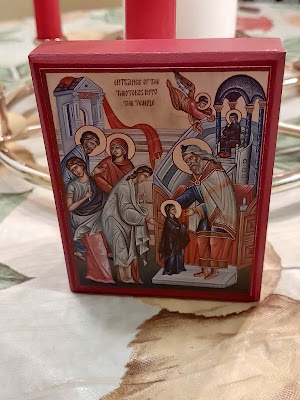
Although the Byzantine rite does not have Advent in the way that we are used to, there is an acknowledgement of the popularity of the Western style devotions in this regard. I purchased the wreath you see above from Legacy Icons, an Orthodox company that I love. It came with this adorable daily devotional:
I'm quite excited for this coming Sunday! The Christmas Bazaar is also scheduled for this weekend, but we're getting a bit of a snowstorm in this area over the course of the entire weekend, so I'm not entirely sure what will happen with events such as this. I'll keep you posted!The Orthodox/Byzantine rite has no liturgical season exactly corresponding to Advent in the West. That does not mean that there is no preparation in the Eastern tradition for Christ's Nativity. In the East, the Nativity Fast begins on November 15th, forty days before December 25th. While there is no weekly "theme" on pre-Nativity Sundays, the season is marked for the penitential singing of "Alleluia" at Matins (Morning Prayer) and other features. As time goes on, more and more Nativity-related hymnody is added to the services. The second Sunday before the Nativity is dedicated to the Ancestors of Christ, and the Sunday before the Nativity is dedicated to the Forefeast, which begins in earnest on December 20th. The Advent season was originally tied to the Epiphany (in the East, the feast of Theophany, on January 6th), with the Birth of Christ being a lesser feast. In the Orthodox West, Advent was first established in 380 as a three-week preparation for Epiphany. Inspired by the development of Lent, by 581 Christians in Western Europe began the Advent fast on Matinmas (November 11th). In other places a period of five or six Sundays was established. After the schism, this was reduced and standardized throughout the West to four Sundays.
The Advent wreath originated among German Lutherans in the sixteenth century. Over time, it became a staple of Advent devotion throughout Western Christiantity, both Protestant and Roman Catholic. While the Advent wreath devotion has no connection to Orthodox/Byzantine rite Christianity, it is deeply ingrained in Western culture. The Eastern forty day Advent season can fall over the course of five or six Sundays, so the focus is on daily rather than weekly devotions (scripture readings, prayers and feast days). It's a private devotion devised to count down to the Nativity. The candles are colored according to the traditional colors of the liturgical season: red for the Nativity Fast, and one blue candle for the Entry of the Theotokos (one of the 12 Great Feasts, and that actually is coming up quite soon!).
Friday, November 11, 2022
Twenty Second Sunday after Pentecost
Thursday, November 3, 2022
Twenty First Sunday after Pentecost
This past Sunday was our final week of Divine Liturgy for October, and it was a beautiful day. This week I finally encountered something I had been wondering about: as the congregation was reciting the Nicene Creed, someone said the filioque clause aloud:
"...and in the Holy Spirit, the Lord, and Creator of life, Who proceeds from the Father and the Son, Who together with the Father and the Son is worshipped and glorified, Who has spoken through the prophets..."Now, in our Byzantine rite parish this part of the Creed in our little missal books looks like this:
"...and in the Holy Spirit, the Lord, and Creator of life, Who proceeds from the Father [and the Son]. Who together with the Father and the Son is worshipped and glorified, Who has spoken through the prophets..."
It's a subtle difference in terms of the actual text, but a MAJOR one in terms of theology, and it is also something about which I do not have a lot of theological background knowledge. I have to admit, I'm quite curious now and intend to do some reading up on this. It is, after all, part of the reason for the continued division between Eastern and Western Christendom, sadly.
When we started attending the Divine Liturgy in the Byzantine rite, I knew about this issue, and noted right away that [and the Son] was in those brackets. So I correctly assumed that the congregation would not say those words aloud, and in fact they did not. This is how it is every week during Divine Liturgy, but this week we had a visitor in the congregation who is almost certainly a Roman Catholic. I hope he didn't feel bad, it's an easy thing to do when you're so used to saying the words, and nobody batted an eye. Plenty of Roman Catholics attend the Byzantine rite Divine Liturgy. In fact, my first thought was:
"One of my peeps is here!" 😁
But it drew my attention to this very important issue. Research upcoming!
#CatholicNerdAlert
And speaking of Catholic nerdiness, I have been absolutely *reveling* in Hallowtide content this week! So by this, we're referring the ancient Church traditions surrounding All Hallows Eve, the feast of All Saints, and the feast of All Souls. To be sure, this is Latin rite me coming to the surface again, because in the Byzantine rite the feast of All Saints is the Sunday after Pentecost.
Whoa.
I don't know that I can mentally make this shift. 😂 I so very much associate November with All Saints and All Souls! My sister Shauna'h put together a free Hallowtide retreat which I went through, and I diligently prayed my Liturgy of the Hours each day. LOVE. I mean, truly LOVE. Our Church is so rich in her traditions!
On the feast of All Saints I attended Mass at Anne's school parish, and I treasured praying the Office of the Dead on the feast of All Souls. The pastor at Anne's school had the 4th graders (who were charged with organizing the masses in November) each say their patron saint and the congregation sang a litany of the saints based on those saints.
So many hearts!
Do you have any special traditions surrounding the feasts of All Saints and all Souls that you participate in each year? Feel free to leave a comment!
Thursday, October 27, 2022
Twentieth Sunday after Pentecost
In our Byzantine journey (interspersed with still quite a lot of Latin rite devotions, because that's how I roll, it appears) we're trucking contentedly along in our post-Pentecost timeline, towards...Advent?
*checks*
Yes, Advent! I know that the traditions leading up to Christmas are somewhat different in the East, so I'm learning as I go here. :-0 There is an Advent fast in the Eastern tradition, and it begins earlier than I'm used to, so lots of details on that to come!
But in the meantime, we were back at Divine Liturgy for the Twentieth Sunday following Pentecost. The Gospel this week in the Byzantine rite was from Luke 6, the tale of the woe of the rich man. Father spoke about how we should strive to be rich in faith and in our relationship with Christ. It was wonderful to be back in that worship space and into the rhythms of the Divine Liturgy.
Afterwards, we indeed chatted about the upcoming parish Christmas Bazaar, which will be held the Saturday before Thanksgiving. All of us are looking forward to helping out and also partaking of the delicious homemade Ukrainian food that will be for sale there! We need to come up with a basket theme idea for the raffle. 🤔
By the way, the cycle of readings is different in the Byzantine rite than it is in the Latin rite, and I've done a bit of snooping on this point. I purchased the book pictured in this post, published by SVS Press, so that I could follow along with the liturgy readings at home on weeks where we attend Mass or if I want a preview before going to Divine Liturgy. There are no Old Testament readings during the liturgy in the Byzantine rite, just New Testament epistles/letters and a Gospel reading, and the cycle of daily readings moves through all of these in a single year. Interesting, yes?
I'm VERY excited about this Advent fast coming up, which begins in mid-November in the Eastern tradition. Expect excitement to come! 🥳
Friday, October 21, 2022
Nineteenth Sunday after Pentecost
Hello all! So glad to have you with me along on this Byzantine journey. This week, I don't have a particularly Byzantine-y post, as Anne and I took a Mom & Me road trip to the NY Sheep & Wool Festival in Rhinebeck, NY, and thus we were traveling during our usual Divine Liturgy time:
![]() |
| She loves car selfies, as you can tell :-0 |
We had a marvelous time, but it was one of those weeks that we had to hit the easy button and find a Latin rite parish where we could quickly slip in for Mass. So no specifically Byzantine content this week, but these opportunities to move back and forth between worshipping in both the Byzantine and Latin rite liturgies is informative in it's own way. I love both traditions, that is definitely becoming clearer and clearer. And I'm increasingly becoming more and more comfortable in both, without things being so lopsided as when I first started attending Divine Liturgy. It's nice to not feel like such a fish out of water over there, and the liturgy makes my heart sing, but at the same time, attending Mass is like a comfy, warm blanket. I'm used to it in the best possible way, and it fits around me so well. I'm grateful that as a Catholic, I can have both!
This Sunday, we're back to the Byzantine rite parish, and I'm certain that talk of the upcoming Christmas Bazaar will abound. I'll have updates next week! Until then, here's some of our new sheep friends from the festival:
Thursday, October 13, 2022
Eighteenth Sunday after Pentecost...
In our Byzantine journey this week, Henry was actually out of town for a cross country invitational, so it was just Anne and I heading to Divine Liturgy. As we settled into our pew, I reflected again that my favorite part of this whole journey East is the language of the liturgy itself. I also love the beeswax candles, the iconography and all of the new saints and traditions I'm learning about, but the liturgy has my heart. One of my very favorite moments in the liturgy is the Prayer before Holy Communion:
I believe, O Lord, and confess that You are truly Christ, the Son of the living God, Who came into the world to save sinners, of whom I am first.
Accept me this day, O Son of God, as a partaker of Your mystical Supper. I will not tell Your Mystery to Your enemies, nor will I give You a kiss as did Judas, but like the thief, I confess to You:
† Remember me, O Lord, when You come into Your kingdom.
† Remember me, O Master, when You come into Your kingdom.
† Remember me, O Holy One, when You come into Your kingdom.
May the partaking of Your Holy Mysteries, O Lord, be unto me not for judgment or condemnation, but for the healing of soul and body.
† God, be merciful to me, a sinner.
† God, cleanse me of my sins and have mercy on me.
† I have sinned without number, forgive me, O Lord.
And after we return from receiving Our Lord, the first words spoken are:
Priest: Save Your people, O God, and bless Your inheritance.
Choir: We have seen the true light. We have received the heavenly Spirit. We have found the true faith. We worship the undivided Trinity for having saved us.
I noticed this past week that at one point, one of the pages in my little Eastern missal stuck to another one, and as I flipped to the "next" page, I immediately recognized that what I was looking at could not possibly be the words we were to speak next. We were missing important material! Then I saw that a ripped page in my missal had caused the snag, and it all made sense. I'm actually starting to memorize portions of the liturgy, and it's feeling more and more comfortable to participate in it. It's a lovely feeling.
Wednesday, October 5, 2022
Seventeenth Sunday after Pentecost
Wednesday, September 28, 2022
Sixteenth Sunday after Pentecost
☕
This weekend we went back to how the Eastern Church marks what we in the West would call Ordinary Time, and thus we were at the Sixteenth Sunday after Pentecost. Our Sunday once again dawned rainy (the new grass we planted is coming in great at least!) as we made our way to Divine Liturgy. Signs are up advertising the Christmas Bazaar that is to come right before Thanksgiving, and we're looking forward to it and feeling a bit more integrated into the parish now. We found our usual seats towards the back of the small worship space, and I let the opening words of the Divine Liturgy of St. John Chrysostom wash over me:
"In peace, let us pray to the Lord."
"Lord have mercy."
"For the peace from above, and for the salvation of our souls, let us pray to the Lord."
"Lord have mercy."
The cadence and language of the Divine Liturgy really speaks to me. Obviously, there's this type of 'call and response', if you will, in all liturgies, including the post Vatican II one that most of us are used to. But there's something about the way it is arranged and verbalized in the Divine Liturgy that I find so spiritually nourishing. Add in the the scent and flicker of the real candles and the iconography covering the sanctuary, and this is why I feel called to come back to this style of worship week after week.
The Gospel this week featured the story of Jesus finding the fishermen and inviting them to become fishers of men. Father spoke about how we shouldn't be afraid to tackle the challenges that come our way in our daily lives, because God is always there, throughout, to support us and get us to where we need to be.
After liturgy, we did our happy congregational chatting thing out in the entry area, accompanied by a nice sensation of being more settled and at home there. What I'm feeling at this point (very early on, to be sure) is that I may simply be a Roman Catholic who feels a pull to the Divine Liturgy and Eastern Christian spirituality; thus, I may never formally be a member of the Byzantine rite. Who knows, there are still 11 months to go, but as much as I love the liturgy and everything that I'm learning about the traditions, I'm still pretty attached to my Western ones. I also love daily Mass, as I discussed last week with regards to the Feast of the Exaltation of the Cross. So while this all is definitely feeding my soul spiritually right now, I don't know that I see myself giving up my Roman Catholic roots. But hey. There is still quite a lot of the liturgical year to go, with the Catholic Nerd set loose with icon sprees and every Eastern prayer book imaginable each week. What could go wrong?
😂
Thursday, September 22, 2022
Sunday after the Exaltation of the Cross
![]() |
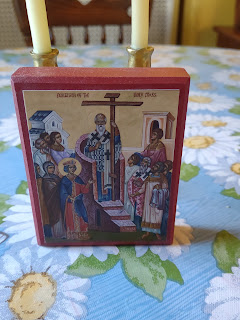
| Icon for the Feast of the Exaltation of the Holy Cross |
Welcome back everyone, hope that you are well! It's getting decidedly fall-ish in my part of the world, and I do love this time of year, although I'm mourning the end of summer, for sure. I'm trying to see the positives in cozy fall weather and fun autumn activities like apple picking and pumpkin shopping, so keeping my spirits high!
It was an interesting week in my little Byzantine adventure over here. Settle in with your coffee or tea and let's chat!
🍵
Last Wednesday, September 14th, was the Feast of the Exaltation of the Holy Cross, and I happened to be off from work that day. I noted in our monthly parish bulletin that there was Divine Liturgy that day at 10 am, and excitedly I set off to attend. I had never attended a weekday Divine Liturgy (is it like daily Mass?) and I was ever so curious.
Well. 😂 I had an interesting experience, to be sure! I arrived at the church, and nearly didn't even go in, because there were no other cars in the parking lot and I was sure that I had made a mistake when I consulted the bulletin. But I figured I would try the door, and curiously, it was open. As soon as I entered that informal space at the back of the building, I could hear chanting, so I knew that somehow, I had in fact been right. When I entered the sanctuary though, I quickly tuned into the fact that it was a small crew for weekday Divine Liturgy. It was me, the lovely lady who was singing, and Father. That's it. 😬 I felt a little awkward, because I'm still so new to the Divine Liturgy, and the liturgy was taking place in Ukrainian (which I knew was likely to be the case), but I figured I would get what I could from context and just being present. I set myself up in the back and just breathed in being in that space, which I absolutely love.
In the spot before the iconostasis where the current seasonal icon is usually set up, there was a display with a cross and flowers. I was curious about liturgical colors in the Byzantine rite, so I did a little research:
Sure enough, the cloth surrounding the cross display was red. I'm already mourning the loss of rose pink for Advent, but we'll talk about that in a few months. 😅
Quickly, Father became aware of my presence, and he *came down off the altar* to hand me a sheet with the readings and Propers on it in both Ukrainian and English, and pointed out where we were, telling me that they were so happy that I was there. After he went back to the altar, they switched to English so that I could follow along with them.
🥰
I felt very welcomed and at home. Occasionally, they switched back to Ukrainian for short stretches, but I easily followed along with the English side of my sheet. What wasn't on the sheet, I found in the Divine Liturgy missal book thingy. 😎 Slowly but surely, I'm figuring things out there.
At the end of the liturgy, there was a special session of bowing and recitations in front of the cross for both Father and our tiny congregation.
Back out in the hallway after liturgy, Father greeted me and asked if I was able to follow along. I assured him that I was, and we chatted briefly about the kids and about how weekly envelopes work in that parish, which I had been wondering about.
It was LOVELY. The richness in that tradition is still keeping me entranced and engaged. In the future, I'm not sure how I'll handle weekday Divine Liturgy opportunities. They went out of their way to make me feel at home, which I appreciate more than I can ever fully express, but the thought did cross my mind that it may be a better fit for me to go to daily Mass, especially when the feast days overlap in both traditions, like this one does. Plus, the schedule for daily Mass often works better with my work schedule, as I'm not often fully off from work during the week (though usually working from home 1-2 days). So the jury is still out on that one, but this weekday jaunt with something new was a very enjoyable adventure.
The following Sunday was officially the Sunday after the Exaltation of the Cross on the Byzantine calendar, but at my son's Catholic high school it was the day for his class liturgy, so we went to Mass over there this week. I missed the Divine Liturgy, for sure, but it felt comfortable being back at Mass, and I was happy to be with Henry for this special event. Later the same day, we did head to our Byzantine rite parish for the big Ukrainian festival/fundraiser they were hosting, and picked up pierogies, sauerkraut and sausage for dinner. This was a collaborative effort of the three Byzantine rite parishes in our region, and the church hall was PACKED! It was nice to see.
Next week we will be back at Divine Liturgy, and our march towards Advent continues! Do they do Advent in the Byzantine rite? 🤔 We're going to be finding out soon, and I can't wait!